Semaglutide patient education has to happen before the first injection, not after the first side effect. A compliant education session covers the boxed warning and who must never receive the drug, the serious risks that require the patient to call, the titration schedule and why it is slow, and the practical counseling on food, muscle and pregnancy that determines whether the outcome is good. This guide covers what belongs in that conversation and in the record of it.
GLP-1 Weight-Loss Pack
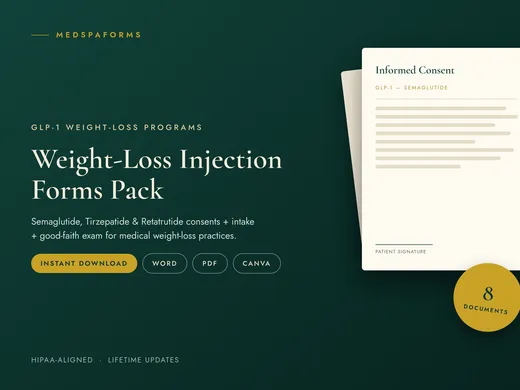
Everything a medical weight-loss program signs: three medication consents current to FDA labeling (boxed warnings included), a weight-loss intake with eating-disorder and MEN2 screens, and a patient education sheet.
See what's inside — $53The boxed warning and who must not receive semaglutide
Start here, because it is the disclosure most likely to be skipped and the one most clearly documented in the approved labeling.
Semaglutide carries a boxed warning for the risk of thyroid C-cell tumors. In rodent studies, semaglutide caused dose-dependent and treatment-duration-dependent thyroid C-cell tumors at clinically relevant exposures. Whether semaglutide causes medullary thyroid carcinoma in humans is not known, because the human relevance of the rodent findings has not been determined. Patients deserve that sentence in exactly that shape: the animal signal is real, the human relevance is unresolved.
Because of that signal, semaglutide is contraindicated in patients with a personal or family history of medullary thyroid carcinoma and in patients with Multiple Endocrine Neoplasia syndrome type 2. Your intake form must ask both questions explicitly, and asking about "thyroid problems" is not sufficient, because a patient with a family history of MTC will not recognize their relative's diagnosis in that phrasing.
Patients must be told the symptoms that require immediate evaluation: a mass or lump in the neck, difficulty swallowing, shortness of breath, or persistent hoarseness.
The second contraindication is a prior serious hypersensitivity reaction to semaglutide or to any excipient in the product.
Serious risks the patient must be able to recognize
Approved labeling carries a defined set of warnings and precautions. Each one should be translated into a symptom the patient can identify and an instruction about what to do.
Acute pancreatitis. Reported with GLP-1 receptor agonists, including fatal and non-fatal hemorrhagic or necrotizing cases. Tell the patient that severe, persistent abdominal pain, often radiating to the back and often with vomiting, means stop the medication and seek care immediately. If pancreatitis is confirmed, semaglutide is not restarted.
Acute gallbladder disease. Cholelithiasis occurred more often on semaglutide than on placebo in trials, and rapid weight loss itself raises gallstone risk. Counsel on right upper quadrant pain, pain after fatty meals, fever, or jaundice.
Acute kidney injury from volume depletion. Persistent vomiting or diarrhea can dehydrate a patient into renal impairment. This is a practical instruction rather than an abstract risk: if you cannot keep fluids down, call us rather than waiting it out.
Severe gastrointestinal reactions. Beyond ordinary nausea, some patients experience severe vomiting, constipation or ileus requiring intervention. Semaglutide is not recommended in patients with severe gastroparesis.
Hypersensitivity reactions. Anaphylaxis and angioedema have been reported. Rash, swelling of the face or throat, or difficulty breathing means emergency care.
Diabetic retinopathy complications in patients with type 2 diabetes, associated with rapid improvement in glucose control. Patients with existing retinopathy need ophthalmologic monitoring.
Heart rate increase. A modest resting heart rate rise is expected; sustained palpitations should be reported.
Pulmonary aspiration during anesthesia or deep sedation. Because gastric emptying is delayed, residual stomach contents have been reported despite adherence to standard preoperative fasting. Instruct every patient to tell any surgeon, dentist, endoscopist or anesthesiologist that they are taking semaglutide, well before any scheduled procedure. This is one of the most consequential and most frequently omitted counseling points.
Suicidal behavior and ideation has been the subject of ongoing regulatory review. Advise patients and families to report new or worsening depression or mood changes.
Add the practical instruction that pens and injection devices are never shared between patients, even with a new needle, because of bloodborne pathogen risk.
Titration, gastrointestinal effects and why patience is the protocol
Nausea is the near-universal experience. In labeling for the weight management product, nausea occurred in roughly 44 percent of patients, diarrhea in about 30 percent, and vomiting and constipation each in about 24 percent. Abdominal pain, headache, fatigue, dyspepsia, dizziness, bloating and eructation follow.
The approved weight management escalation for the injectable product moves in four-week steps: 0.25 mg weekly for weeks one through four, 0.5 mg for weeks five through eight, 1 mg for weeks nine through twelve, 1.7 mg for weeks thirteen through sixteen, and 2.4 mg from week seventeen onward as the recommended maintenance dose. Reaching maintenance therefore takes sixteen weeks. If a patient does not tolerate a dose during escalation, delaying the increase by four weeks is the labeled approach.
Explain the pharmacology, because patients who understand it stop asking to move faster. Semaglutide has a half-life of about one week, so concentrations need roughly four to five weeks to plateau after each step. Escalating early does not accelerate results; it accelerates side effects and dropout.
Give concrete tolerance strategies: smaller portions and stopping at the first sense of fullness, reducing fat and fried foods, eating slowly, staying upright after meals, maintaining fluid intake, and treating constipation early with fiber and hydration. Set the expectation that nausea is usually worst in the days after an increase and settles within the four-week block.
Cover the mechanics too. Once weekly, same day each week, any time of day, with or without food. The day may be changed if at least 48 hours separate doses. A missed dose can be taken within five days; beyond that, skip it and resume the schedule.
Hypoglycemia, interactions and pregnancy
Semaglutide alone rarely causes hypoglycemia in patients without diabetes. The risk appears when it is combined with insulin or an insulin secretagogue such as a sulfonylurea. Labeling advises considering a dose reduction of the concomitant insulin or secretagogue when starting semaglutide, and recommends blood glucose monitoring before and during treatment.
Every patient on those agents must be taught hypoglycemia symptoms, carry fast-acting glucose, and know when to call. Any patient with diabetes must be co-managed with their prescribing clinician rather than treated in a silo.
Also cover delayed gastric emptying as an interaction mechanism, which can affect the absorption of oral medications, and counsel patients on oral contraceptives, narrow therapeutic index drugs and thyroid replacement to raise it with their prescriber. Alcohol tolerance frequently changes, and heavy use raises pancreatitis risk.
On pregnancy, semaglutide may cause fetal harm and is not recommended for weight management in pregnant patients. Labeling directs discontinuation at least two months before a planned pregnancy because of the drug's long half-life. That two-month window is a specific number patients need to hear, not a vague instruction to stop beforehand.
Counsel patients of childbearing potential to use effective contraception and to report a suspected pregnancy immediately. Mention that weight loss can restore ovulation in some patients, so an unplanned pregnancy is a real possibility for someone who previously assumed low fertility. A pregnancy exposure registry exists for patients exposed during pregnancy.
Muscle mass, protein and what success should look like
This is where good practices separate themselves, because it is not a labeled warning and is therefore often skipped.
A meaningful share of the weight lost on GLP-1 therapy is lean mass rather than fat, with published estimates commonly in the range of 20 to 30 percent of total weight lost. That is not unique to these drugs, since any substantial caloric deficit costs lean tissue, but the appetite suppression makes inadequate protein intake very easy to fall into.
Counsel deliberately. Prioritize protein at every meal, since many patients simply cannot finish a large plate and will default to whatever is easiest. Commonly cited targets for preserving lean mass sit at or above roughly 1.2 grams of protein per kilogram of body weight per day, distributed across meals rather than concentrated in one. Pair that with resistance training two or three times per week, which combined with adequate protein is more effective than either alone. Ensure adequate fluid, and review micronutrient intake in patients eating very little.
Reframe the goal in the education session. Success is fat loss with preserved strength and function, not the number on the scale falling fastest. Baseline and periodic body composition measurement, where available, makes that conversation concrete.
Compounded semaglutide and the extra counseling it demands
If your practice dispenses compounded semaglutide, the education requirement is materially higher.
In 2024 the FDA alerted providers, compounders and patients to dosing errors with compounded injectable semaglutide. Reports described patients receiving five to twenty times the intended dose. Contributing factors included unfamiliarity with drawing medication from a vial, and confusion between milligrams, milliliters and syringe units. In one reported case a prescriber intending 0.25 mg, equal to 5 units on the syringe in that concentration, wrote 25 units. Resulting adverse events included nausea, vomiting, abdominal pain, fainting, headache, dehydration, acute pancreatitis and gallstones, with some requiring hospitalization.
The root cause is that compounded vials come in varying concentrations, so the number of units representing a given milligram dose differs between pharmacies. A patient who switches suppliers, or a staff member who reuses a familiar figure, can produce a large overdose without noticing.
Practical safeguards: supply the correct syringe for the prescribed dose and concentration, write the dose in milligrams and in units and state the concentration on the instruction sheet, demonstrate the draw and require teach-back before the patient leaves, provide a dosing calendar, verify with the patient at every dose change, and re-educate whenever the pharmacy or concentration changes.
Patients should also be told plainly that compounded preparations are not FDA-approved products and have not undergone FDA review for safety, effectiveness or manufacturing quality, and that the compounded regulatory landscape has tightened considerably since the FDA declared the semaglutide shortage resolved in February 2025. That disclosure belongs in the consent form, not only in conversation.
The bottom line
Semaglutide patient education is a defined set of disclosures rather than a general chat about weight loss: the boxed warning and the two absolute contraindications, the symptom-level red flags for pancreatitis and gallbladder disease, the sixteen-week titration and why it cannot be rushed, hypoglycemia risk when combined with insulin or a secretagogue, discontinuation two months before a planned pregnancy, and protein plus resistance training to protect lean mass. If the product is compounded, add the syringe, the units, and a teach-back, because the documented dosing errors came from unit confusion rather than from the drug. Document the education itself, since a chart note recording what was taught is what shows the counseling actually happened.
Frequently asked questions
Who should not receive semaglutide?
Semaglutide is contraindicated in patients with a personal or family history of medullary thyroid carcinoma, in patients with Multiple Endocrine Neoplasia syndrome type 2, and in patients with a prior serious hypersensitivity reaction to semaglutide or any product excipient. It should also be avoided in pregnancy, and caution is warranted in patients with a history of pancreatitis or severe gastroparesis.
Why does semaglutide dosing start so low?
The 0.25 mg starting dose is below the therapeutic range and exists purely to let the body adapt to a GLP-1 receptor agonist with the least nausea possible. Semaglutide has a half-life of about one week, so blood levels take roughly four to five weeks to stabilize after each increase, which is why escalation intervals are four weeks rather than shorter.
What makes compounded semaglutide riskier to counsel on?
In 2024 the FDA reported dosing errors with compounded injectable semaglutide in which patients received five to twenty times the intended dose, often because concentrations differ between pharmacies and because patients and prescribers confused milligrams, milliliters and syringe units. Every compounded patient needs the correct syringe, a written dose in both units and milligrams, and a teach-back demonstration before leaving.
Related templates
Free template for your practice
Get a ready-to-edit version of the document this guide describes, plus new templates as we publish them. One useful email now and then, no spam.
This guide is educational and is not legal or medical advice. Verify requirements with your own advisors and your state board before applying them in your practice.