"Botox certification" is a training certificate, not a license, and it is issued by private companies rather than by any state board. It matters for competence, employment and insurance, but it never creates the legal authority to inject. That authority comes from a clinical license that already permits administering prescription medication, plus a lawful relationship with a prescriber who evaluates each patient and issues an order. Understanding that distinction is the difference between a compliant injectables program and an enforcement file.
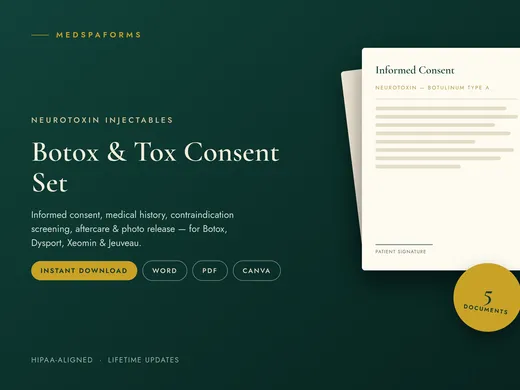
Botox & Tox Consent Set
Five documents for neurotoxin practice (Botox, Dysport, Xeomin, Jeuveau): consent with the FDA boxed warning, medical history, contraindication screening with provider disposition, aftercare and per-product off-label mapping.
See what's inside — $18What a Botox certification actually is
Search "Botox certification requirements" and most results describe a course: a day or two of facial anatomy, product comparison, reconstitution, dosing, injection technique for the glabella, forehead and lateral canthal lines, complication recognition, and supervised hands-on injecting on live models. That is genuinely useful education, and reputable programs are worth paying for.
What it is not is a credential recognized by a licensing authority. There is no Botox board, no registry of certified injectors, and no state that lists "botulinum toxin" as a license type. The certificate is closer to a continuing-education record than to a license. This is why people who confuse "Botox certified" with "Botox licensed" get into trouble: they treat a receipt for training as permission to practice.
Manufacturers reinforce the confusion with their own branded programs. Allergan, Galderma, Merz, Evolus and Revance all run training and account programs, and completing one is often a condition of buying product. That is a commercial requirement, not a regulatory one, and satisfying it does not answer the scope question at all.
The actual prerequisite: a license that already allows injection
Botulinum toxin products are FDA-approved prescription drugs. Administering a prescription drug is a medical act. So the real requirement list is short and starts with your license.
| Credential | Grants authority to inject | What it actually does |
|---|---|---|
| State medical license (MD/DO) | Yes | Full authority to evaluate, prescribe, inject and delegate |
| NP / APRN license | Yes, subject to state practice authority | Independent in full-practice-authority states; collaborative agreement elsewhere |
| PA license | Yes, under a physician relationship | Delegated prescribing and injecting per state supervision terms |
| RN license | Administration only | May inject on a patient-specific order after a prescriber's good-faith exam |
| Esthetician / cosmetology license | No | Skin services within cosmetology scope; never injections |
| Botox certification from a training company | No | Documents training and competence; no legal effect on scope |
| Manufacturer account training | No | Commercial condition of purchasing product |
Read down that table in order. If the first column does not already contain injection authority, nothing further down the list supplies it.
What "Botox certification by state" really means
Plenty of pages publish state-by-state Botox certification charts. They are not describing certifications. They are describing four state variables that determine who may inject and under what conditions, and it is worth naming them precisely so you can research your own state efficiently.
Prescriptive authority. Whether an NP can prescribe independently or needs a collaborating physician. Roughly thirty states plus D.C. grant full practice authority; the rest require an agreement.
Delegation and supervision. Whether an RN may inject, and whether the delegating provider must be on site, immediately available or simply reachable. This is the variable that most often surprises owners expanding into a second location.
The good-faith exam. Who may perform the pre-treatment medical evaluation, and whether telehealth qualifies. In most states an RN may inject but may not perform this exam.
Ownership. Whether the corporate practice of medicine doctrine restricts who may own the practice that bills for the treatment.
None of those four are things a certificate can change. All four are things a board will answer in writing if you ask.
What good training should actually cover
Given that no regulator sets a curriculum, judge programs on content and on hands-on time. A serious course covers facial anatomy in depth, including the frontalis, corrugator, procerus and orbicularis oculi, and the danger zones where diffusion causes ptosis. It covers all the approved toxins rather than one brand, with realistic dosing conversions between them, since units are not interchangeable across products.
It should also cover reconstitution, storage and handling; patient selection and contraindications including neuromuscular disorders, pregnancy and lactation, and active infection at the site; documentation and photography; and management of complications from bruising to eyelid ptosis, including what apraclonidine is for and when to refer. Hands-on injecting on live patients under direct observation, not on mannequins alone, is the part you are really paying for.
Ask how many patients you personally inject during the course, who supervises, and what post-course mentorship exists. Those answers separate a credential mill from an education.
Where a certificate matters, and what it does not replace
None of this means certification is worthless. It matters in four concrete places.
Employers use it as a screening minimum, and many will not schedule a new injector without it. Malpractice carriers ask about training when underwriting aesthetic procedures, and a gap in documented training is a coverage conversation you do not want to have after an adverse event. Manufacturers condition account access on it. And in a board complaint or a lawsuit, documented training is part of how you show you met the standard of care.
That last point is the honest case for certification. It does not create authority; it helps defend the exercise of authority you already had.
Every injectables encounter needs a documentary spine, and no course completion substitutes for any part of it. The good-faith exam note, signed by the physician, NP or PA who performed it. The patient-specific order or protocol authorizing the product, dose and areas. An informed consent naming the product, disclosing off-label use where applicable, and listing realistic risks including asymmetry, ptosis, headache and lack of effect. A treatment chart note with product, lot number, expiration, dilution, units per injection point, an injection map, and the names and credentials of both the injector and the supervising or ordering provider. And an adverse-event protocol that says who to call.
Keep training certificates in the personnel file alongside license verification, malpractice certificate and competency sign-off. Keep clinical documents in the patient chart. Auditors look in both places, and they look for different things.
Red flags in training programs
Be skeptical of any program that advertises certification to non-clinical students, promises that its certificate lets you inject anywhere, claims to be state-approved without naming the agency, offers no live hands-on injecting, or bundles a product-purchasing arrangement in a way that blurs who the prescriber is. Programs that sell "medical director in a box" alongside training deserve particular scrutiny, because the medical director relationship has to be real, documented and clinically active to mean anything.
The bottom line
Botox certification is training, and training is valuable, but the requirement that decides whether you may inject is your state clinical license plus a lawful prescriber relationship for each patient. Physicians, NPs and PAs generally may evaluate, order and inject; RNs may inject on a patient-specific order after someone else performs the good-faith exam; estheticians may not inject at all. Choose a course on anatomy depth and live hands-on time, not on the wording of the certificate. Then build the file that actually protects you: exam note, order, consent and chart note naming the supervising provider, for every single patient.
Frequently asked questions
Is there a national Botox license?
No. No federal agency and no state board issues a Botox license or a Botox certification. Every certificate on the market comes from a private training company, a manufacturer or a professional association, and it documents training rather than granting legal authority.
How many hours of Botox training do I need?
No state sets a mandatory hour count for cosmetic botulinum toxin training, so the answer comes from employers, malpractice carriers and your own competence. Most credible introductory courses run one to two days and combine facial anatomy, dosing, injection technique, complication management and live hands-on practice on real patients.
Can a certification course make me eligible to inject if I am an esthetician?
No. Training cannot expand a license, and no state permits an esthetician to inject botulinum toxin. If a program markets itself as making non-clinical students eligible to inject, treat that as a serious warning about the program.
Related templates
This guide is educational and is not legal or medical advice. Verify requirements with your own advisors and your state board before applying them in your practice.